
When you fry butter, its 19% water turns to steam, creating a foam that rides through the fat and keeps the temperature near 100°C while the water lasts. Once the steam disappears, the remaining fat and milk solids heat up quickly, reaching their smoke point around 350°F (177°C). At that point the Maillard reaction browns the solids, producing the burnt flavor and aroma you notice. If you keep going, you’ll discover more ways to stop it.
Quick Guide
- Butter’s ~19 % water turns to steam, creating a foam that buffers heat and keeps the pan near 100 °C while water remains.
- When the water evaporates, the foam collapses, removing the thermal buffer and allowing the fat temperature to rise rapidly.
- The sudden temperature spike triggers Maillard reactions in milk solids, causing browning, toffee‑like aromas, and eventually burning.
- Regular butter smokes around 350 °F (175 °C); above 375 °F (191 °C) the safe window shrinks to seconds, especially with uneven pan heating.
- Using medium heat, adding a neutral oil, or switching to clarified butter (smoke point ~450 °F) prevents the water‑loss burn.
What Makes Butter Foam and Then Heat Up Fast?

Why does butter foam and then heat up so quickly? When you melt butter, its 19% water turns to steam, creating bubbles that rise through the fat and form foam. This steam keeps the temperature near 100 °C, acting as a thermal buffer. As long as water remains, the heat rises slowly; once the water evaporates, the fat temperature spikes, leading to rapid heating. Like cooking eggplant seeds, cooking reduces bitterness by changing how certain compounds behave under heat.
How Does Water Evaporation Trigger Butter Burning?
When the water in butter finally evaporates, the temperature of the remaining fat and milk solids shoots up dramatically. You’ll hear large bubbles pop as water boils off, then frothing stops and all moisture is gone.
Without water to absorb heat, the butterfat and milk solids heat rapidly, triggering the Maillard reaction. Within seconds, browning turns to burning, producing smoke and a bitter taste. The Maillard Reaction creates aromatic compounds that give brown butter its nutty flavor. Even in refrigerated storage, keeping foods between 34–40°F helps limit bacterial growth and preserve best quality.
Why Do Milk Solids Cause Smoke After the Foam Stops?
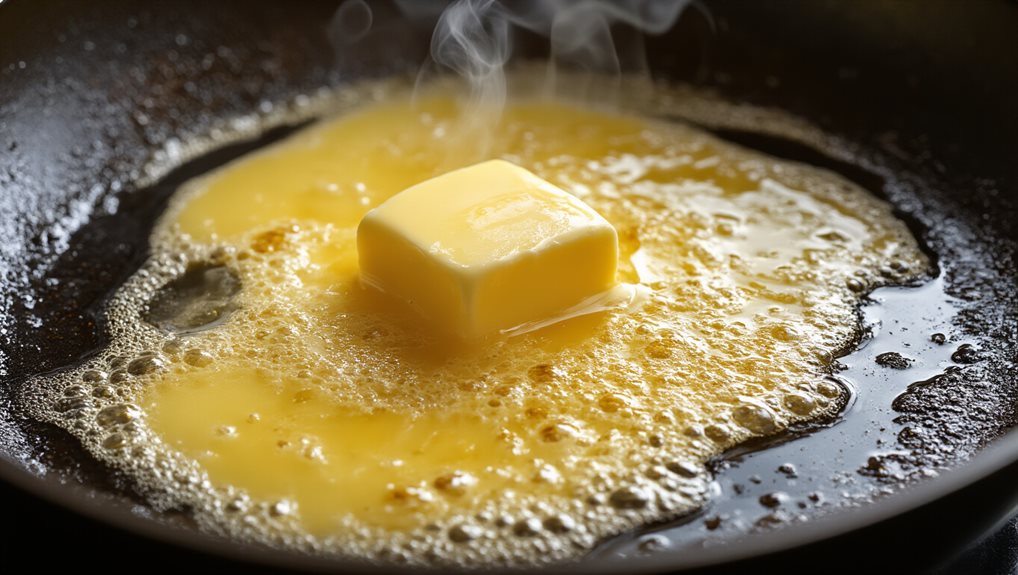
After the foam disappears, the water that once protected the milk solids is gone, and the temperature in the pan spikes. The now‑exposed proteins and lactose heat quickly, and the Maillard reaction browns them, producing toffee‑like aromas. If you don’t stir, the solids scorch on the pan’s bottom, releasing smoke that signals the shift from browning to combustion. The high milkfat content in butter lowers its smoke point, making the remaining lipids oxidize faster once the water evaporates. Keep fats away from heat between uses, since light, heat, and oxygen speed oxidation and can worsen off flavors and smoke.
What Temperature Thresholds Dictate Butter Burning Time?
You’ll notice that regular butter starts smoking around 350 °F, and the clock starts ticking as soon as it hits that threshold.
If you push the temperature a bit higher, say to 375 °F, the smoke appears faster, cutting your safe cooking window to just a few seconds.
Just as moisture exposure can create temperature fluctuations that speed quality loss in pantry staples, uneven pan heat can shorten the time you have before butter starts to smoke.
Knowing these heat‑level limits and the corresponding time until smoke helps you stay within the safe range and avoid burning.
Thresholds Per Heat Level
So, which temperature actually triggers butter to burn? At 150 °C you evaporate water, preventing splatter.
Between 170 °C and 180 °C butter cooks foods for about ten minutes before browning begins.
Smoke appears near 175 °C (350 °F), marking the burn onset.
Push to 190 °C, and you have only a few minutes before rapid degradation, so monitor closely.
Time Until Smoke
When the pan reaches the butter’s smoke point, the clock starts ticking, and you’ll see smoke within seconds to a few minutes depending on the exact temperature. At 350 °F regular butter smokes in about 30–60 seconds, while unrefined butter at 302 °F may take a minute. Clarified butter at 450 °F can stay clear for 2–3 minutes before smoke appears. Higher temperatures shorten the window dramatically.
Safe Cooking Window
Where does the safe cooking window for butter begin and end? You stay below 300 °F for low‑heat tasks, keep sautéing under 350 °F, and limit basting to a 350 °F maximum. If you blend butter with oil, you can stretch to 400 °F, but pure butter should never exceed its 350 °F smoke point, or it will burn quickly.
How Can I Prevent Butter Burning While Pan‑Frying?
Ever wonder why butter seems to turn black in seconds on a hot pan? Heat the pan on medium, then add a splash of neutral oil before the butter. Keep the temperature around 160 °C, watch the foam, and add butter toward the end of cooking. This timing and gentle heat prevent milk solids from burning while preserving flavor. Just as spoilage indicators like sour smells or slimy textures warn you food has gone off, the aroma and color changes in butter are quick cues that your pan is too hot.
When Should I Switch to Clarified Butter or Oil?

Curious about the exact moment to swap regular butter for clarified butter or oil? When you see smoke approaching 350°F or the butter foams and browns quickly, switch. Clarified butter raises the smoke point to about 450°F, letting you sear proteins, fry breadcrumbs, or stir‑fry vegetables without burning. Use it when you want butter flavor at high heat, or choose neutral oil for even higher temperatures or longer cooking.
Wrapping Up
You’ve learned that butter burns because its water evaporates, its milk solids scorch, and its temperature climbs past safe limits. By watching the foam, adjusting heat, and adding oil or using clarified butter, you can keep the pan at the right temperature. These simple steps let you enjoy buttery flavor without smoke or burnt bits, making pan‑frying both tasty and under.

