
Your macarons don’t have feet because something went wrong at one of a few key stages. Your meringue may not have been stiff enough, your batter could’ve been over- or under-mixed, or your shells didn’t rest long enough to form a proper skin. Oven temperature also plays a huge role — too high causes cracking, too low stalls the rise. Keep going to fix each of these issues for good.
Quick Guide
- Skipping the rest period prevents skin formation, causing flat shells with no feet during baking.
- Under-whipped or over-whipped meringue lacks proper stiffness, weakening the batter structure needed for feet.
- Overmixing creates runny batter that destroys surface tension, preventing feet from forming properly.
- Incorrect oven temperature—too high or too low—disrupts the rising process necessary for feet development.
- High humidity or oily almond flour adds excess moisture or fat, weakening meringue and preventing feet.
What “No Feet” Actually Means (And Why It Happens)
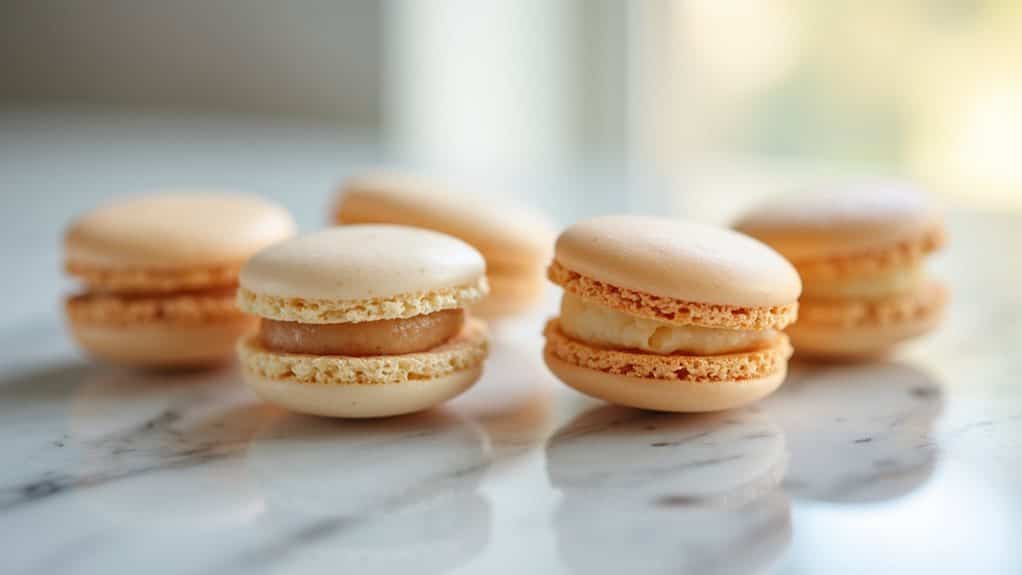
When your macarons come out of the oven without that distinctive ruffled edge at the base, they’re missing what bakers call “feet.” Feet form when the batter’s surface dries into a thin skin before baking, then expands upward and outward from the bottom as heat pushes the batter up.
Just like dry and wet modes optimize sealing for different foods, macarons need the right surface dryness before baking to rise and form feet.
Skipping drying time, overmixing your batter, or using the wrong oven temperature prevents proper skin formation, leaving your macaron shells flat.
How Stiff Your Meringue Needs to Be to Form Feet
Your meringue needs to reach stiff, glossy peaks before you fold it into the batter, and you can test this by lifting your beaters and checking that the tips stand upright without drooping.
If your whites look dry, clumpy, or dull, you’ve gone too far, and overbeaten meringue will actually prevent feet from forming just as much as underbeaten meringue will.
Aim for that sweet spot where the mixture is shiny and firm, holds its shape completely, and doesn’t wobble or slide when you tilt the bowl.
Just like eggplant seeds can taste bitter if left raw and benefit from cooking, meringue that isn’t properly “cooked” through stiff, glossy peaks can throw off your final texture.
Ideal Meringue Stiffness Levels
Getting your meringue to the right stiffness is one of the most critical steps in forming feet on your macarons.
Whip your egg whites until they form stiff peaks that stand upright, appearing smooth and glossy.
Under-whipped meringue lacks structure, while over-whipped meringue loses its texture and can’t trap air.
Either extreme prevents feet from forming during baking.
Signs of Overbeaten Whites
Stiff peaks are what you’re aiming for, but there’s a fine line between perfectly whipped and overbeaten meringue.
Overbeaten egg whites turn dry and grainy, losing their glossy appearance and structural integrity. This loss of stability makes folding difficult and prevents proper foot formation.
Instead, you’ll likely end up with cracked shells or hollow shells that completely collapse during baking.
How Mixing Errors: Over or Under: Destroy Macaron Feet
Mixing your macaron batter is a delicate balancing act, and getting it wrong in either direction will cost you those signature feet.
Over-mixing makes your batter too runny, destroying surface tension and preventing feet formation.
Under-mixing leaves it too stiff, blocking proper air incorporation and macaron structure development.
Both errors compromise batter consistency, so proper folding is essential for achieving successful feet formation.
Just like signs of rancidity signal it’s time to discard avocado oil, a batter that turns runny or stays stiff is a clear warning that your mixing has gone too far in either direction.
Skipping the Rest Period Prevents Feet From Forming
Resting your piped macarons before baking isn’t optional — it’s what creates the skin that makes feet possible. Skipping the resting period leaves macaron shells too moist, causing them to spread flat.
Proper resting allows skin development on the surface, trapping air for feet formation. Without adequate drying time, shell texture suffers — producing sticky, smooth tops instead of the characteristic ruffled feet. Keep them in an airtight container away from heat once cooled to prevent moisture issues later.
How Oven Temperature Determines Whether Feet Develop
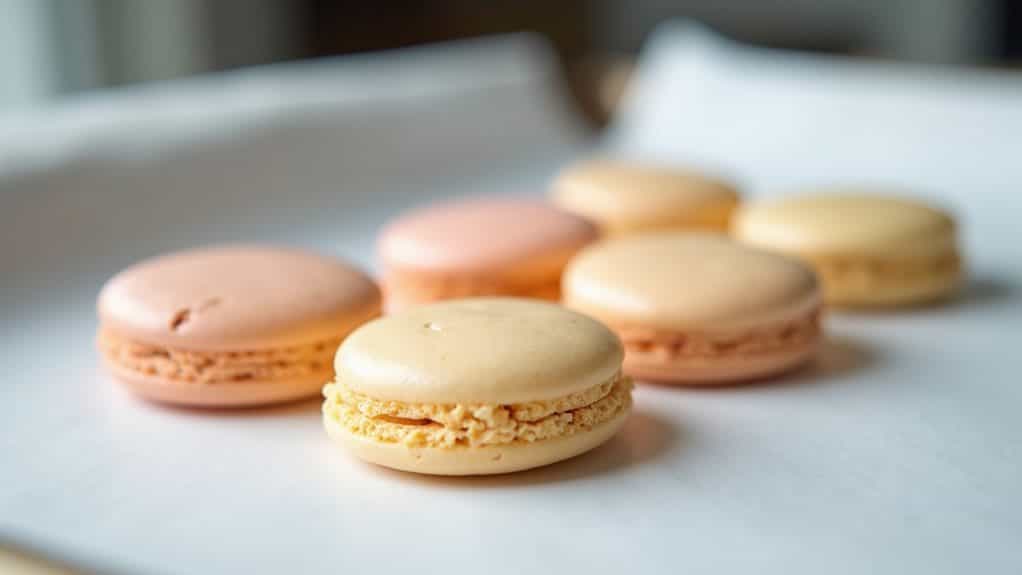
Oven temperature plays a critical role in whether your macarons develop feet or come out flat. Too high, and your shells crack before feet development begins.
Too low, and the shell rise stalls completely. Uneven heat from poor oven calibration creates inconsistent results.
Aim for 300°F and use an oven thermometer to maintain steady temperatures throughout your baking time.
How Oily Almond Flour and High Humidity Kill Feet Formation
Even if your technique is perfect, oily almond flour and high humidity can silently sabotage your macarons before they ever reach the oven.
Excess fats in your almond meal weaken the meringue structure, disrupting batter consistency and blocking feet formation.
High humidity adds unwanted moisture to your dry ingredients, making the batter too wet for shells to develop the tension needed to lift and form feet.
For comparison, even products like cream cheese can undergo texture changes when frozen due to ice crystal formation, showing how small shifts in moisture and structure can dramatically affect baking outcomes.
How to Test Whether Your Batter Is Ready to Form Feet
To check if your macaron batter’s ready to form feet, use the ribbon test by lifting your spatula and watching how the batter falls.
If it flows off in thick, slow ribbons and leaves a glossy trail that smooths out within 30 seconds, you’re in good shape.
You can also pipe a small test dollop; if it holds a slightly domed top without spreading flat, your batter’s at the right consistency to develop those coveted feet in the oven.
Ribbon Test Technique
Once you’ve mixed your batter, the ribbon test will tell you if it’s ready to form feet. Lift your spatula and watch how the batter flows.
Proper viscosity means it falls slowly, forming a thick ribbon that dissolves after 30 seconds.
Under-mixed batter drips too quickly, while over-mixed batter spreads too thin.
Your mixing technique directly impacts whether your macaron shells develop feet.
Batter Consistency Indicators
Beyond the ribbon test, there are a few more ways to verify if your batter has the right consistency to develop feet. Your batter should look shiny smooth, almost like molten lava.
When piping, watch for peak formation—it should briefly hold, then settle. If you notice excessive spreading during piping, your runny batter indicates over-mixing.
Proper folding guarantees the development of feet during baking.
Wrapping Up
Getting macarons with perfect feet isn’t luck—it’s technique. You’ve now got the knowledge to troubleshoot every common failure point, from weak meringue to a humid kitchen. Check your stiff peaks, nail your macaronage, rest your shells until they’re dry, and dial in your oven temperature. Once you control these variables, you’ll see those ruffled feet every time. Small adjustments make a big difference, so don’t give up after one bad batch.


